Friday, April 28, 2023

Sei Solo per due


In 1982, Karlheinz Stockhausen gave a speech to introduce his month-long residency at the conservatoire in The Hague, in which he stated:

I believe in a master, a teacher, only if he is able to play himself – if he cannot play he should not teach – and this explains why I asked to be allowed to bring with me to The Hague the singers, dancers and instrumentalists with whom I have worked for many years so that the young people can see and hear how they work. (Cf. here.) 

The argument is somewhat crooked: clearly, the teaching to be done in The Hague was going to be that of aligning the performance practice of Stockhausen’s works with his compositional intentions. This approach is common in new music, especially with composers who don’t have time to work with musicians on pieces that have already been premiered. When I contacted Kagel to engage with him with regards to his music for the piano, he initially referred me to his trusted Aloys Kontarsky.

For early music practitioners, this exact composer-performer collaboration is obviously not possible, but, inversely, their repertoire benefits from being the object of interest to countless more historians than what recently composed music habitually enjoys. Long before artistic research was formally imagined, musicians who initiated and developed HIP had their noses in period treatises, often with a degree in musicology in their pocket. No wonder that many artistic research PhD candidates are situated in the early music sector, aiming to tailor their performance practice to insights drawn from historiographical research that they carry out themselves.


All the more surprising, then, to see this CD that came out a year ago, featuring both violinist Daniel Auer and musicologist Dagmar Glüxam on its cover, indicating an in-depth collaboration in a project on Affektenlehr and Bach’s works for the solo violin.

According to her CV in the booklet, Dr. Glüxam can be considered an "internationally active" violinist, and her website lists professional concerts as well as having founded her own ensemble with period instruments. For this project, however, she appears  to have preferred to leave the performance of Bach's music to someone else, even if the latter, as heard on a video introducing the project (cf. here), had some initial difficulties identifying with the musicological findings of Dr. Glüxam.

The video promises that the booklet accompanying the CD is "more than a hundred pages", but that is only technically 82, and taking away translations, photographs and bios, we are left with a 32-page German essay. This text starts with the "justification" for this recording, which is stated as (with my highlighting) "[t]his is probably the first one made of an interpretation achieved through consistent application of the principles of affect theory and musical rhetoric." This reads like an odd marketing disclaimer, as if to make sure the project wouldn’t be dismissed as failing to introduce new knowledge other than through the consistency of the application, but claiming it without conviction. An artistic researcher would be expected to know not only the traditional literature on a given topic, i.e. peer-reviewed monographs and articles, but just as well the relevant performance practice, i.e. the recordings of the violinist-peers. In this case, that would have meant that the Sei Solo research were to have been based on the fact that there is, for sure, no such recording yet made, and include a study of what was (not) achieved in those comparable efforts.

I practiced the violin myself, but only for some five years, so I don’t consider myself expert enough to comment on any previous recordings of these Bach pieces, nor on the performance by Auner in this particular CD. I will remark, though, that he states to have used a modern bow and modern tuning. His strings are the Dominant Pro type by Thomastik Infeld (who have "generously supported" the violinist), but on Auner’s personal website, we read (here) that he used "besonderen Barock-Saiten" developed by that company. (On the company’s website, neither I nor a professional violinist-colleague of mine found any mentioning of such special strings.) The explanation for the non-period tuning and bow is limited to claiming that the project’s concepts “need not be restricted to specialists on period instruments”. While I certainly see value in attempting to reach out with the affect theory to violinists who play in otherwise non-HIP ways, it would have been impossible for an artistic researcher to leave the consequences unaddressed. In fact, whereas the essay includes the discussion of "interpretive consequences", of translating an understanding "accurately into sound", and criticizes modern performances of lacking an adequate distinction between "light" and "heavy" playing, it is hard not to wonder why no wider framework of HIP and related in-depth concerns have been looked into.

I do have extensive experiences as recording supervisor, and to read about how

On a harmonic level, the severity of a dissonance (as well as the length of the tone in question) dictates the performer’s dynamic approach: the "harsher" the chord and the longer the notes, the more emphatic or even more aggressive the dynamic needed to evoke the intended affect.

makes me notice even more how sharp and crisp the violin sounds in all of the sonatas and partitas, and not just when a tritone takes centre stage. It also leaves the impression that at least some of the types of "pronunciation" have not solely been a matter of playing, but also of capturing the sound in the studio. But how to appreciate the differences, then?

All in all, I really enjoyed listening to and reading about this project. But as it is of little relevance to my expertise, I have refrained from buying Glüxam’s book Aus der Seele muβ man spielen. While the volume promisingly contains almost 1000 pages, filled with what looks like an exceedingly detailed treatment of the affect theory, it is prohibitively priced at 198€, with a discount of one cent for the pdf.

This is certainly not the first project for which a musician takes into account the work of a musicologist. To my knowledge, though, it is the first time that the scholar gets equal representation on the promotional level. Glüxam may have demanded to visualize her involvement, given the fact that the project was funded (cf. here). Strange, then, that her personal website has no mentioning of this particular output of the collaboration, other than listing the monograph and the Wiener Urtext Edition. On the other hand, and thinking back to what I noticed in a new DGG recording with Zimmerman playing Schubert (see here), this Bach CD may be yet another way in which a label searches for new power in attracting the attention of potential buyers.

In any case, this effort may be the first in a new tradition of giving musicologists more credit for their work, helping them in turn to valorize their efforts in establishing social relevance. It may also point to a possible change in attitude: in a conversation I had with a music theorist, a decade ago, about the potential for music theory to develop insights that could be of use to performers, he argued that scholars should be left to decide for themselves what they wanted to research. Of course, with my nose deep into matters of artistic research, my most pressing feeling is that of looking forward to this project, itself, being investigated from an artistic research perspective. We could then learn more about what things are like when the master is doing the playing.

Monday, March 13, 2023

Topical overview of the blog posts


A blog is often meant and taken as something ephemeral. However, I noticed how readers look for bygone posts. To make browsing this blog easier, and since blogger.com doesn't seem to offer this, I hereby list the topics in this blog. I will keep adding to this categorical list as I add posts to the blog, and you should keep seeing it as "featured post".


Matters of discipline

* Very brief, first post 👉
* What is AR? Opening musings on the question of definition 👉
* Breakthrough research 👉
* Composition
- When Composition is not Research 👉 
- When Composition is not Research2 👉
- When Composition is not Research3 👉
- Scott McLaughlin’s report 👉
- UK debate & AEC white paper 👉
- Composition as critical practice
• the call 👉
• the complete published introduction to the proceedings & a bit on the then (2022) most recent UK Research Excellence Framework 👉
* Conducting 👉
* Conflating the arts (SHARE) 👉
* Countries and their own situations
- Two programs in Salzurg (incl. wider Austria) 👉 
- The Case of Germany 👉
- Brazil 👉
- The Netherlands (and the Professional Doctorate) 👉
- UK
• REF 2014 👉
• REF 2022 👉
* Embodied knowledge and the Frascati Manual
- A move to put our mark on the Frascati Manual 👉
- A move to put our mark on the Frascati Manual² 👉
- The novelty test and the reproducibility criterion 👉
* Expertise 
- expertise-specific conferences 👉
- collaborative Bach project 👉
- particularities of expertise 👉 
* Florence Principles 👉
* 1st honorary doctorate in AR 👉
* Non-Western music 👉
* Novelty test & reproducibility criterion 👉
* Play or perish? 👉
* The Professional Doctorate 👉 & 👉 
* Titles: importance, status, usage
- the sarcastic post 👉
- some more in connection with the Professional Doctorate 👉  
* The Professional Doctorate 👉 & 👉 


Education

* AR at the Master level 👉
* Non-Western music 👉
* Play or perish? 👉
* The Professional Doctorate 👉 & 👉


For students

* AR vs. collaborating with a musicologist 👉
* The Belle van Zuylen Prize 👉
* Context 👉
* The defence of my dissertation at Leiden University, with some history and details of the protocol 👉 
* Language 👉
* Presentation
- Wagenaar's art 👉
- PechaKucha 👉 
* Play or perish? 👉
* The Research Catalogue, the Journal for Artistic Research, and the Society for Artistic Research
- ARC, JAR, SAR 👉
- Have you created your first weave yet? 👉
* Writing
- dissemination success, incl. some statistics 👉
- Writing about contemporary artists 👉
- CD booklets 👉


Projects & People

* Daniel Auner & Dagmar Glüxam's Bach 👉
* Tom Beghin’s Beethoven Broadwood project 👉
* Paul Craenen’s PhD 👉
* Peter Dejans’ honorary doctorate 👉
* Alain Franco’s WTK project 👉
* Michael Picknett’s Devised Music 👉
* Lauren Redhead 👉
* Hans Roels 👉
* Jaso Sasaki 👉
* Anna Scott & Valentin Gloor: “when Brahms met Debussy” 👉
* Mareli Stolp - Reflexivity 👉
* Willem Albert Wagenaar 👉
* Lena Weman’s Studio Acusticum Organ project 👉
* Jed Wentz’ PhD 👉


Gremia

* EPARM 👉
* the Journal for Artistic Research and the Society for Artistic Research 👉
* Practice-Research-Unit 👉
* SHARE 👉
* Scottish Journal of Performance 👉


Events (chronological)

* ORCiM research festival (Belgium) 2010 👉
* Excellence in Research conference (Belgium) 2010 incl. on peer review and the link to things economical 👉
* Academy for Music and Theory (Belgium) 2011 👉
* ORCiM seminar on Artistic Experimentation (Belgium) 2011 👉
* Practice-Research-Unit conference (UK) 2011 👉
* Oslo symposium The Art of Artistic Research 2011 👉
* From Output to Impact conference (Belgium) 2014 👉 
- call 👉
- program 👉
- proceedings 👉
* “Can Composition and Performance be Research?” (UK) 2015 
- anouncement 👉 
- Scott LcLaughlin’s report 👉 
* Conference on conducting by the Oxford Conducting Instituut 2015 👉
* “Composition as critical practice” (Belgium) 2016 
- call 👉 
- proceedings, incl. complete published introductory essay, & a bit on the then most recent UK Research Excellence Framework 👉
* Writing about contemporary artists conference (UK) 2017 👉
* ‘Hands on’ piano conference (Portugal) 2018 👉
* Sound Arguments workshops (Belgium) 2023 👉
* The Belle van Zuylen Prize 👉


Jobs

* 2013 👉
* 2014 👉
* 2014 👉
* 2016 👉
* 2017 New Professorship 👉
* 2022 doctoral positions 👉


Monday, February 20, 2023

Breakthrough research


                                                               To:       Universal Edition
Karlsplatz 6, 1010
Vienna, Austria

Dear person,

We had a little mishap, some weeks ago. I had been hoping to buy the score of Hans Otte’s 1960 Daidalos from you, but since you don't consider this work as part of the current repertoire, and there are no resources to examine the materials in your archive, you could not but disappoint me.

These are difficult times. To think of how UE was once supported by “important personalities from the banking sector”, as I read on your website, and how the company name “was both program and strategy: it simply meant the whole world of music, in which one had some catching up to do”... Especially noteworthy, I find, is the era of director Alfred Schlee, showing a deep commitment to modernist music.

I always had great sympathy for UE’s efforts to promote such music. Perhaps the first score I ever bought from you – Boulez’ Sonata No. 3 – was not as practical as the pianist in me had wished for (pretty colours, but I could just never get it to stay upright against the music stand), especially at that price. Fortunately, it looks great hanging on the wall.

Despite some less than happy collaborations, UE and I have enjoyed at least a joint faith in the future of music that can be perceivced as difficult. In my consecutive careers as pianist and concert organiser, I have put countless UE scores on the stage. Now I am a researcher, and I find myself potentially aligned with UE’s fate, or at least with its erstwhile ambitions, once again.

A little while ago, the New York Times published the news of how science doesn’t anymore provide the breakthrough research results that society needs in order to thrive. The study criticised ‘incremental science’. One of the authors is a specialist in "strategic management and entrepreneurship", bringing to my mind the image of research managers studying ways to increase the impact of their employees’ work. It made me think of some directors of research institutions that I have known, telling their staff that they were not impressed by research showing how bar six in Berio’s violin Sequenza contains a mistake. It might just about impress a violinist, but it doesn’t change society. So why spend society's money on it, right? Anyway, said study seemed to me an example of incremental progress rather than the disruptive type that it warns us we should be focussing on. 

The NYT article mentioned Einstein’s breakthroughs as being more typical of a past that we don’t seem to connect to anymore. But some of Einstein’s efforts turned out to be proven only relatively recently, didn’t they? So it can be argued, like people such as Schlee did, that disruptions à la Schönberg's don’t necessarily become apparent or have a societal impact straight away, either. 

Perhaps that moment is upon us, however. I am writing all this because of another bit of news, also about societal changes. As it seems, some of Roald Dahl’s books are being rewritten to suite present-day sensitivities. I can imagine some artists exclaiming that we should leave the past as it was, and that we won’t learn from it if we rewrite it. But we could just as well argue that we rewrite history as soon as we research it. And what's wrong with having multiple perspectives at the same time? If a Dahl story is well rewritten, then it will reach a larger audience, so that a larger number may get excited to go and find the inappropriate original. An enterpreneur would call it a win-win situation.

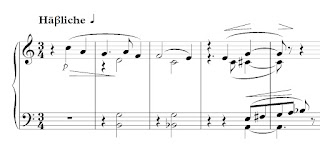
Anyway, I just got this idea. What if we rewrite Schönberg? Adjusting his notes to the prevalent taste of today's audiences might not just make his music more “schön”, it might provide us with a huge opportunity for employing re-composers and publishing their work. And we could disrupt at least the modernist part of the musical society. Imagine all the music from your catalogue that we could finetune! We might even make enough money to pay someone to go look for that Daidalos score in your archive. Maybe a simple overhaul is all it needs to be rescued from its current oblivion.

To show my genuine interest in this idea, I took the liberty of trying it out on one of your company's most succesfull modernist output: Schönberg’s opus 11. I only took the first few bars, as this is what researchers have traditionally limited themselves to. (In any case, the whole work is also mostly known only to white male pianists, but that is a problem in itself, worthy of a differently focussed research application. It is perhaps best to be disruptive in an incremental way.)

Herewith, I include my rewrite for you to evaluate. There are details to discuss, of course - the f#, for instance - but we can deal with semantics after we agree on the fundamentals. Let me know how it strikes you. I feel confident there is material for an EU application.


I look forward to hearing back from you.

Meanwhile, I remain yours with my best regards.

Tuesday, January 31, 2023

The "Professional Doctorate"


Last summer, a festive kick-off was organised to formally introduce the new Dutch initiative of the “Professional Doctorate pilot Arts + Creative” (PD), which aims to cater to artists who want a third cycle degree but not a PhD.

The Dutch landscape has seen quite a few doctoral trajectories already: docARTES, PhDarts, MERIAN, GRASP, Creator Doctus, and RASL. Grosso modo, those can be categorised into the two types that determine much of the wider (ongoing) third cycle degree debate. When the Bologna Declaration, and the nuances in the subsequent Bergen Meeting, initiated the European doctorate for artists, it left the decision on how to flesh out the degree content to the individual actors. Most have gone for a research degree, which has led to collaborations between arts institutions and universities; others have chosen the option of a performance degree, which compares to the well-known D.M.A. in the US. Both (most often) include a written and artistic component, but the primacy and relation of one vs. the other varies: for the research-degree, the candidate has to show how the findings constitute new knowledge and how that changes their practice, while the performance-degree is less dependent on the verbalisation. As much as there are nuances to be found within each of the degree types as offered by institutions, there are also different visions on how they compare, and what exactly (ought to) constitute research. (More on this here.)


The new PD is organised by 15 Dutch arts and design schools, including those who had their own non-PhD program, in the list above, as well as some – e.g. the Amsterdam Hogeschool der Kunsten – who already participate in one of the PhD programs. So the PD is a matter of consolidation as much as a new initiative, countering a hitherto confusingly splintered and unevenly successful landscape.

Of the Dutch programmes listed above, the first four lead to a PhD. Creator Doctus doesn’t (not even a written dissertation is required), and I assume RASL didn’t either – the latter’s webpage has disappeared, probably because it is now part of the PD consortium. As the Creator Doctus program does not accept any applications anymore, I gather that is for the same reason. In any case, Creator Doctus resulted in one artist obtaining a “degree”, and another project was started in 2020. GRASP has not seemed to provide information on participants; MERIAN has two candidates in the running, both visual artists. Interestingly, MERIAN stresses that their PhD is “in Maastricht-style artistic research”, reminding us of how the “Brussels model” (cf. here) was thought out and given its own name to seek distinction at the level of understanding AR.

Since the kick-off, a “pre-PD program” was set up, but that is now finished. This first month of 2023, the pilot is to have started with “a first cohort of candidates in five domains, including the creative domain”, enabling the schools to appoint 34 candidates in total. At the moment of writing this, no music student has entered the pilot. The matter of who will pay for it is not clearly settled, yet. The Dutch government was asked for some 56 million euros for the entire pilot, but I have been told that the organising schools would have to pay for that out of their existing budget.

The only FAQ on the PD site is about the legal question of the title. Elsewhere, it is stated that the PD “is the equivalent” of the PhD, demonstrating that it is not the same. (See here for some more on this matter.) The PhD degree is protected to the point that the PD will have to introduce a new name for it, and have that certified by the Dutch government. This will take two years, so the organisers expect to legally secure it before the pilot is concluded. Nevertheless, the wording in the FAQ is carefully chosen so as not to jump the gun: the most optimistic phrase is that “the Minister is positive about the development of the PD phase”, meaning the pilot, not necessarily the acceptance by parliament of the new degree. Oddly, it is stated that [my highlighting]: “following and completing a PD trajectory in the pilot phase (and afterwards) can lead to a broader career perspective and career opportunities.”

The hesitant phrasings are understandable from a legal perspective, but my feeling on this whole initiative is more positive. As a PhD holder myself, this might be surprising, especially given my responsibilities as a co-coordinator of an artistic research PhD program. But I have seen how and understand why many musicians decide not to get a PhD. Most of those who enter a PhD program submit a solo project. Some are involved in ensemble work, but their research is steering the group and its workings. So what about orchestra musicians, who may develop innovations for their instrument and/or their repertoire, but who will have to negotiate with the conductor how much of it they may be permitted to apply on stage? Given the inevitable inflation in degrees, in the next decades, all types of musicians may want a third cycle degree to be able to obtain a faculty position at some conservatoire, not necessarily with any interest in reorienting their careers towards doing research as well as performing. Until now, the only route for a musician towards a third cycle degree in The Netherlands was through the docArtes PhD programme. The PD would give musicians a choice. (In the UK, not having a PhD doesn’t seem to deter musicians from entering academia, although a total absence of an academic degree seems to result in issues of clashing cultures - cf. here.) Personally, I don’t think the PhD programmes will loose applicants to the PD, for I have no doubt the research trajectory will continue to inspire and attract musicians. The only downside I imagine at this point, is that we may continue to see confusion between different degrees and programmes that are called PhD or something seemingly close to it, at least for a while yet, until things settle.

Wednesday, December 21, 2022

Titulaturiana


In James Parrott's Oscar-winning 1932 Laurel & Hardy movie The Music Box, the two protagonists are trying to deliver a heavy crated player piano up a long stretch of steep, narrow public stairs. At one point (see here, at 10'05") they are confronted by a gentleman coming down those stairs. The actor Billy Gilbert expertly builds up the socially awkard way in which his character tries to cope with the road block. While at first he doesn't seem to know how to communicate efficiently with the two workmen, his temper gets the better of him when they propose he walk around the obstacle. In order to impress upon them the preposterous nature of that suggestion, he employs a full verbalization of his status: "Me, Professor Theodore Von Schwarzenhoffen, M.D., A.D., D.D.S., F.L.D., F.F.F. ánd F should walk around?" 

The professorial confrontation in The Music Box (1932)


The intonation of the last three words may have the same root as the famous though more recent "handbag" exclamation by British actress Edith Evans. Gilbert has reported that he "decided to do a German accent" to distinguish himself from other actors playing comedy villains with Laurel & Hardy. Even if his memory of that intention was correct, he sounds decidedly more British than German in my ears. Either way, the British upper class is as much a trope in films as is the character of the German professor. Famously, the 1920 Das Cabinet des Dr. Caligari and the 1930 Der Blaue Engel had depicted authoritarian but socially inept and alienated figures that are given academic nomers. Some have taken this as far as argueing that this would be symptomatic of a subconscious need in German society for a tyrant to lead them, but the mad certified expert had taken hold in other corners of the cinematic world as well, and even earlier, cf. the 1902 French Le Voyage dans la lune, with the character of Professor Barbenfouillis "satirizing the pretensions of professors and scientific societies." 

Asserting one's social position by way of titles also resonates with the British class and honours systems, of course. It ought not to be surprising, therefore, that it has been singled out for comedic effect on the Anglo-Saxon island just as much, if not more. Professor Von Schwarzenhoffen may have accumulated some six titles (of which only Doctor of Medicine and Doctor of Dental Surgery make obvious academic sense), Monty Python went all the way in the 19th sketch of their 1970 "How to recognize different parts of the body" (see here), where an omnidisciplinary surgeon has so many titles to display on his office desk that a special construction was needed to mount them all. As in The Music Box, only some of the degrees listed are potentially real. And as much as Von Schwarzenhoffen's F.F.F still possibly refers to something medical (e.g. the otolaryngological abbreviation for Fibula Free Flap), the Python sketch also pokes fun at the denominational traditions themselves: if you were FRS, FRCS, FRCP, as well as FRCOG, and trained at Oxford, it would have been perceived as less than imposing to add that you had an M.S. from Guadalajara; "B.Litt (Phil)" points not only to the confusing historical relation between the British Bachelor of Letters and Doctor of Philosophy, but goes on to joke on "Phil"; etc. (And yes, Medicine Hat is a place in Canada.)


Monty Python's The Nose sketch, with Professor Sir Adrian Furrows F.R.S. F.R.C.S. 
F.R.C.P. M.D.M.S. (Oxon), M.A. Ph.D. M.Sc. (Cantab), Ph.D. (Syd), F.R.G.S., 
F.R.C.O.G., F.F.A.R.C.S., M.S. (Birm), M.S. (Liv), M.S. (Guardalajara [sic]),
M.S . (Karach), M.S. (Edin), B.A. (Chic), B. Litt. (Phil), D. Litt (Phil),
D. Litt (Arthur and Lucy), D. Litt (Ottawa), D. Litt (All other places in Canada
excep
t Medicine Hat), B. Sc. (Brussels, Liege, Antwerp, Asse, (and Grower))


TV and film tropes are only that because of a basis in real life. And that real life concerns not only historical figures, as for instance Horatio Herbert Kitchener, 1st Earl Kitchener, KG, KP, GCB, OM, GCSI, GCMG, GCIE, PC (1850-1916). Still today, post-nominals seem important to some. I have received emails signed "Dr. [X], BMus, MMus, PhD, Hon RCM, FRSA". And when I witnessed the setting up of a research group, with the members to be called "fellows", there was first a debate about how to distinguish post- from pre-docs (solved easily enough by adding "doctoral"), then about allowing for seniority on the post-doc level itself. For years, it wasn't clear whether a fellow was just that, or whether s/he was in fact a senior fellow who didn't play along.

In wider social circumstances, abbreviated titles can lead to "knight fever" for those who are not to the manor born: how to address someone with pre- and post-nominals, what is the right order of the titles on the seating distribution cards,...? In a professional context, it can of course be important to know who has which type of expertise, exactly. Collaborating with a PhD can be different from working with a D.M.A. (But, yes, Dr. Phil had a proper DPhil degree.) 

Naturally, homo ludens sometimes nuances things into the unworkable, making for some counterefficient situations. For some, the real doctorate is only the DPhil. This is generally considered the same as PhD (philosophiae doctor = doctor philosophiae), "the most common degree at the highest academic level awarded following a course of study", but which is nevertheless only one of e.g. the 51 doctoral titles in the U.S. alone. Next to it, a number of "equivalent" doctoral degrees are recognized, for instance the D.A. (occasionally D.Arts or Art.D.), and neither the US Department of Education nor their National Science Foundation discriminate between them. Already in 1967, this Doctor of Arts degree was offered in Fine Arts as well as History, English, and ... Mathematics. It is even reported that a National Doctor of Arts Association (NDAA) was founded at the State University of Idaho. If only the current address were disclosed, so that one could properly apply to become a fellow.

Not all countries are that open. In 2011, the German Prof. Dr. iur. Dr. h.c. Peter M. Lynen defensively argued for a doctorate in the arts to be a dr. Art and dr. Mus rather than a PhD (see my post on The case of Germany). And despite being alleged as having "defined the differences between a Doctorate in the Arts compared to a scientific doctorate or Ph.D. degree", the 2016 Florence Principles on the Doctorate in the Arts (see here) acknowledge the different names that institutes give (p. 4: "DCA, DPhil, PhD, DFA") but nevertheless proceed to talk about PhDs.

If Peter Lynen lists two doctorates among his prenominals, one earned (in law) and one honorary, it goes to show that the distinction is deemed necessary. To boot: not every doctor becomes professor, and not every professor is a professor. In my home town (Ghent, Belgium), a conservatoire teacher is a "docent" (member of the faculty), but for international communications, some will translate this as "professor". Of course, that annoys the "ordinary professor" ("gewoon hoogleraar") at the university, who already has to contend with the fact that s/he is - counterintuitively - ranked higher than the "extraordinary professor" ("buitengewoon hoogleraar").

Outside of the DCA, DFA and PhDs, artistic research also has e.g. Dr. Artium and Creator Doctus. This creativity in avoiding the name PhD is rooted in the protection that universities seek against the possible erosion of their quality standards at the level of the PhD. Hence the issue of having 'degree-awarding power' or not. Not every country allows its universities to just start a doctoral program, so not every university will like to see Fine Arts institutes or conservatoires granting a PhD without having the necessary certifications themselves. That is why most non-university art institutions collaborate with a (nearby) university, accepting the latter to rule on the use of titles. In The Netherlands, a new artistic research doctoral trajectory will be tested from January 2023 onwards, catering to musicians who don't want to do a PhD, and it is already clear that a new name will have to be chosen (possibly 'PD', as in 'professional doctorate' - see my next post). 

Even those who are still working towards getting a PhD (or an equivalent) can be confronted with issues of titles. Again in The Netherlands, the law allows those with a masters to automatically consider themselves as "doctoranda/doctorandus" (dra./drs.), i.e. on the way to getting a doctorate - whether actually enrolled or even planning for it or not. Because of the obvious confusion, a student in a doctoral trajectory is now called "promovenda/us".


There are reasons for keeping certain distinctions, even beyond knowing what expertise you are seeking to engage with. When I coordinated a doctoral program in artistic research, I got emails from a US student who wanted to know if ours was leading towards "a fully-fledged" PhD. If it weren't, she thought she might as well stay in the US to obtain a DMA, which she said was a "second rate degree", meaning that too many already had one, so that a PhD was more efficient in securing a job. Hence the professional doctorate having tried to NOT have to look for a name that isn't PhD. This is close to what is known - in The Netherlands, once more - the "civil effect". That term is used for specifically graded legal degrees in order for them to be valid for certain professional activities. If you did the mandatory years of law school but you did not take some particular courses, the civil effect is not indicated on the degree and you can therefore not become e.g. a notary. Such particular practices do not as a rule apply to artistic research, but it is not difficult to imagine a director of a conservatoire, in some not-too-distant future, having to fill a vacancy and choosing from a large number of applicants of which most have a masters and only some have a doctorate. That director may be hard pressed not to use degree ranking as a short cut. (This speculation is supported by OECD numbers from 2019 on labour market outcomes - see pp.252-253 here.) At any rate, when I was offered my coordinator job, it was made explicitly clear that this was mainly because of my degree - "we can no longer have someone with a masters running a doctoral curriculum". And the times are long gone when it looked cool to say, like one of my conservatoire friends in another century: "I think I should like to go to Paris and get a baccalauréat in something".