Showing posts with label Leiden University. Show all posts

Monday, October 03, 2011

"Who's gonna read this ?"


A friend of mine, in the midst of the final rush towards finishing his dissertation, vented his contradictory feelings of dutifulness and despair: "for whom am I doing all this??" I always considered myself lucky to not have suffered from this state of mind, as the answer had been obvious to me. I was also extremely confident that 'they' would want to read it, and my experiences ended up proving me right. For a presentation on post-doc artistic research life, I took the trouble of investigating the matter into some detail. I think it is uplifting and promising.

I started my doctoral research long before an artistic doctorate was an option. In the early 1990's, coming back from the US with lots of inside information from my working with composers that I knew my fellow new music pianists in the EU were lacking in their performance practice, I had decided to write a book. Compelled to reach as many musicians as possible, merely teaching didn't look as if it was going to be satisfying. Even if I got a position at a conservatoire, I'd still be looking at reaching some 200 to 300 students at best during the rest of my teaching career. There were going to be concerts, of course, but passing on the kind of professional performance practice information that I had to spare did not suite the stage: the questions on 'how did you do that?' would still be left unanswered. A book it was going to be. In English, of course: the few dozen Dutch speaking new music pianists would hardly make the effort worthwhile.

In 1996 I heard of a new institute that would support and frame projects that were too big to fit conservatory degrees. It looked perfect for my idea, so I hooked up to the Orpheus Institute. After a few years, Bologna became the name for a process that lead directly to the artistic doctorate and my book became a dissertation without much ado. A burn-out and many pages later, in 2009 the dissertation-book was finished and in March 2010 it was put on the repository of Leiden University, where it can be viewed and downloaded for free.

A nice feature of the repository enables the visitor to see the statistics on how many people view and/or download dissertations, revealing the worldwide interest by country, referrer and month.
Here is the ratio views/downloads for the first year per month:

                            2010/03       13  /    11
                            2010/04       96  /    77
                            2010/05       73  /    67
                            2010/06       28  /    40
                            2010/07       13  /    08
                            2010/08       11  /    10
                            2010/09       23  /    18
                            2010/10       19  /    14
                            2010/11       21  /    14
                            2010/12       54  /    44
                            2011/01       36  /    22
                            2011/02       23  /    34
                         
                                TOTAL     410  /   359

[ updates: 2011/03-'12/02 :     379  /   258
                2012/03-'13/02 :     498  /   289
                2013/03-'14/02 :     631  /   381
                2014/03-'15/02 :     625  /   281
                2015/03-'16/02 :     654  /   289
                2016/03-'17/02 :     866  /   375
                2017/03-'18/02 :   2302  /   400
                2018/03-'19/02 :   2564  /   491
                2019/03-'20/02 :   1481  /   535

                            TOTAL   : 10410  / 3658 

UPDATE Oct. 2022: the Leiden University repository has stopped giving the detail of the statistics as listed above. I can now only see the numbers for the calendar year and for the last three months. So I have decided to stop updating this list.]

The surge in April is probably due to the fact that I announced the repository on Facebook. I have not made any targeted publicity campaign since then, not even by way of a link on my homepage or in my e-mail signature. There is an increase in September 2010 and March 2011, two months in which prospective doctoral students are in touch with me about their entrance exam and application for our doctoral program. One would expect them to look for examples of artistic research dissertations, but the few such students don't completely explain the differences. I have no idea why there's a peak in December 2010. (The total views/downloads for March 2010-October 2011 are 585/481.)

The happiest remark to be made concerns the realization that one year has been enough to reach more individuals than I would have hoped for in several decades of teaching. Not all of these views and downloads (the numbers don't overlap, by the way) can be assumed to lead to actual knowledge transfer and application, but that isn't guaranteed with teaching either.

It can also not be taken for granted that all the viewers and downloaders are pianists, but search keyword information suggests that most of them are. Through my profile on Academia.edu, where a link to the repository can be found, I can see the keywords that were entered into search engines and that lead the surfer to my profile page. Apparently, views and downloads are not so much generated by any particular interest in me as a person, or in a more general interest in artistic research. Hardly ever do I see my name pop up - mostly, it is 'extended techniques for piano' or some other combination of such words that the search engine then links to the title of my dissertation. I cannot imagine many non-pianists wanted to download a large file with information on piano performance techniques. Together, the search information and the repository statistics show that people find the dissertation because they look for the content: they are in need of the knowledge. The answer to my friends exasperation with the effort to write his dissertation and the fear of it being in vain - "Why would anyone want to read what I have to say?" - is very clear, and very exciting, I think.

Here is the list of 25 dissertations from other departments of Leiden University that were put in the repository at the same time as mine, again with the ration view/download for the 12-month period March 2010-April 2011:

                          48/292    Medicine
                          50/220    Medicine
                          26/94      Law
                          60/139    Biosciences
                          93/261    Social and Behavioral Sciences
                          36/237    Physics
                          60/465    Medicine
                        134/199    Observatory
                        133/125    Humanities
                          89/312    Art History
                          35/205    Medicine
                          51/309    Medicine
                          48/139    Medicine
                          85/416    Biology
                          31/209    Medicine
                        148/217    Environmental sciences
                          55/704    Medicine
                          45/243    Medicine
                          56/141    Medicine
                          33/236    Medicine
                          50/158    Psychology
                        139/465    Institute for Area Studies
                          74/207    Medicine
                          18/110    Psychology
                          66/465    Medicine

I can only wonder at why certain dissertations seem so much more or less sought after than others. Of immediate interest here is the fact that the views are mostly much less than the downloads. Compared to the other disciplines, my dissertation has more views (449) than any of the others (max. 148). In my case, the proximity of view- and download-numbers can be explained by the supposition that a new discipline leads people to have a look at output out of interest more than to have and use the content. I surmise that established disciplines have developed a tradition of interested parties systematically downloading new knowledge to have and read it.

If any of my numbers are a success, it has - again - nothing to do with me or any notion of quality: the numbers for my colleague doctors in the arts with a dissertation at the Leiden University repository are equally impressive. If mine is the 6th in a ranking of most downloads, compare to the other 25 (better are medicine, biology, and 'area studies'), Paul Craenen's 216 downloads in six months and Jed Wentz' 450 in nine months will be as much up there, if not more, when their first post-doc year is over. Paul and Jed's viewing numbers (185, resp. 334) are and will likely remain lower, which may be explained by the novelty wearing off. (My dissertation was the first artistic research output on music in The Netherlands, the country which many of my viewing numbers came from; it was also the only one at the repository for nine months.)

In terms of geographical interest, Paul generated views and downloads from a total of 18 countries, jed 22 and I 59. It is true that automated search engines will get to the repository without a genuine interest in the matter, but these will not result in actual downloads. In all three cases, only two to three countries had had someone viewing while nobody downloaded.

I didn't study the differences in download/viewing behavior according to country: Paul's dissertation is written in Dutch and Jed's and mine in English, the subjects are wildly divergent, etc. Of further interest, however, is the fact that only Jed's dissertation was (twice out of 334 views and 450 downloads) referred to by Google Scholar. This can show how most of the interest is from musicians rather than musicologists: few of the former typically use Google Scholar.

All this is very exhilarating for the artistic research discipline and its researchers: it proves that musicians all over the world are hungry for this type of knowledge to enrich their expertise. And they are willing to go to great lengths for it: I made a limited number of hardcover bound copies of my dissertation to give to family, promotor etc. Some pianists pleaded with me to sell them one (as they didn't like reading from a monitor or printing out a thousand pages), and when they heard from me that the cost to make some more would run up to 80€ per copy, they argued that they would pay much more than that to have it. I can only imagine one bigger incentive for publishers to take artistic research very seriously: there are many more musicians than academics. And they need catering to.

Thursday, May 19, 2011

Remembering W.A.Wagenaar and his legacy


During the previous doctoral training session of the Orpheus Institute, Willem Albert Wagenaar passed away. I have written about him earlier, but it is fitting to do so again at this sad occasion as his role in the making of the - apparantly - most sought after doctoral trajectory for musicians in the Low Countries has been more decisive than is generally known.

Willem Albert Wagenaar, artistic research

Dutch psychologist Willem Albert Wagenaar (Utrecht, June 30, 1941 – April 27 2011) studied in Utrecht, Leiden and Pennsylvania State University. He has been professor at both Utrecht and Leiden Universities and is seen as a specialist in matters of human memory. As an expert witness he gained international recognition in court cases such as the one against John “Ivan the terrible” Demjanjuk. Wagenaar avidly collected Magic Lanterns – generally accepted to be invented in the 17th century by Christiaan Huygens, another one of Leiden University’s brilliant students – for which passion he had a home theater built, aptly called the “Christiaan Huygens Theater”. (You can see video’s of Wagenaar’s Magic Lantern presentations here and here.)

Willem Albert Wagenaar, artistic research, Christiaan Huygens Theater
Wagenaar's Christiaan Huygens Theater

At the turn of the last century, it was Wagenaar who decided to make a phone call that would eventually lead to the bestowing of the PhD title on creative and performance artists at Leiden University. At that time, Wagenaar was Rector Magnificus of Leiden University, which housed no department handling any focus on music. He fostered the grand thought of the creative arts themselves (not just their study from outside of the practice) constituting an integral part of the university’s responsibility towards society and its knowledge. It was Wagenaar who initiated contact with the Royal Conservatory at The Hague and its then director Frans de Ruiter to set the ball rolling and to see how collaboration could be worked out on the practical level, i.e. how students from both types of institutions could benefit from such an integrated approach towards science and artistic practice. During the discussions that ensued, the academic notions of research and doctoral promotion were put on the table, pragmatically followed up in turn by pioneering efforts to envision what a PhD trajectory in artistic research could or should be like. It was eventually decided that this project deserved a faculty of its own, and in 2001 the Faculty for Creative and Performing Arts (for which de Ruiter acted as its dean) officially combined the Royal Conservatoire and Royal Academy of Art (both at The Hague) with Leiden University in an extraordinary education and research program. (It was later renamed as the Academy for Creative and Performing Arts.) 

Academy for Creative and Performing Arts, artistic research, Leiden

Wagenaar’s vision departed from the idea that the historical separation between the arts and sciences had been unjust:

It has long been thought that it was possible to make a good, profitable distinction between arts and sciences because it allows to simultaneously draw a line between ability and knowledge. Science concentrates on knowledge; the ability that follows, doesn’t really belong to it and should be taught outside of the university. […] In the arts, then, it would be mostly about ability without knowledge; that’s why we have separate institutions. As such, we take care that knowledge, as produced by the history of music, of art, of literature, is strictly separated from the world of skills, such as needed to sing and paint. But this distinction is not profitable and not real. The boundary between art and science is based on completely absurd notions about delineations between knowledge and ability, and should therefore be abolished.

[From Wagenaar’s inaugural speech at the launch of the Faculty of Creative and
Performing Arts.]

It is interesting that Wagenaar’s demarche was somewhat independent of the EU’s Bologna declaration, in which a bachelor-master-doctorate structure was decided upon for restructuring higher education in the arts. Wagenaar’s ideal superseded this mere three-fold differentiation, wanting to offer different types of merging scientific with artistic education. At the newly established Academy for Creative and Performing Arts, students can combine optional courses from both scientific and artistic institutions, as well as enrolling in new types of masters (e.g. media technology, in collaboration with the faculty of mathematics and physics), in a simultaneous combination of fully-fledged scientific and artistic trajectories, and in an artistic doctoral trajectory, all jointly operated.

The integration of arts and sciences is not unique in the world: especially in the Anglo-Saxon higher education tradition, it is common practice. But on the old continent, Wagenaar’s vision was revolutionary. Since the renaissance, the unity of arts and sciences had eroded, resulting in conservatoires, art academies and universities as separate entities with their own mission concepts and funding. Even in the Low Countries, where artistic research is supported with a surprising sense of unanimity, Wagenaar’s project predates the more loosely-knit Flemish model of university-conservatoire associations, and the real integration of the arts into universities is still less than a worked-out plan.

Willem Albert Wagenaar, artistic research

After his position as rector, and for the rest of his life, Wagenaar closely followed the developments of what he had set in motion. He was a member of the promotion committee of the first promovendus of the Academy for Creative and Performing Arts (yours truly) and continued to be involved in all the artistic research promotions up to and including the last weeks of his life, reading the dissertations and posing his questions during the promotional rituals.

At least in the Low Countries, and potentially elsewhere, Artistic Research owes considerably to this soft-spoken and sweetly kind man with an advanced vision on artistic practice and education.


[UPDATE]

On a Dutch blog remembering Wagenaar, I read more on this fascinating man. Aparently, he received his double first name (Willem Albert) from his two grandfathers. As a kid, he saw the advantage in the two chocolate letters he got from Santa Claus; later on, the double intellectual inheritance - the one grandfather's scientific interests and the other's artistic appreciation - clearly helped shape his vision of an artist's place in the university.

A final anecdote demonstrates how Wagenaar was a creative scientist until the end of his life: getting lost in the woods around his home town, the pressure under his skull made him hear magpie chatter as a trumpet passage in Stravinsky's Rite of Spring, develop a panic fear of flowers, of the sent of lilies and jasmine. "My condition leads to completely new experiences that only patients can have! What luck that the cancer is my head. It is much more interesting than in any other body part." In the mean time, a booklet has been made to offer doctors insights and fellow patients support. Wagenaar had become the object of his own study as much as the artistic researcher that he had envisioned would investigate his own experiences for the benefit of scientists and colleague artists.


Wednesday, March 30, 2011

Dr. Paul Craenen


Yesterday afternoon, at 4.15pm, Leiden University and docARTES saw Flemish composer Paul Craenen defend his research to become Doctor in the Arts.

Paul Craenen, artistic research

The subject concerned “composed performers” and applied the perspective of the composer to investigate the body in musical performance. The remarkably well-written dissertation (download here - buy the English publication here) looks at this topic from a thoroughly thought-out set of angles, including the body of the composer himself, the relation between performing bodies and instruments, technology and space (physically sounding and mentally perceived) and embodiment of silence as well as non-linearity. More than showing how his insights influenced his compositional practice, the dissertation gives a very detailed and in-depth account of the status of this subject in recent history. The relation with his own, extremely creative work was revealed in the concert and lecture that preceded the day of the promotion. 


Paul Craenen, artistic research, Dubbel Gaan
P. Craenen: Dubbel Gaan (2007-08)

The value of the research goes beyond showing how Dr. Craenen thinks about the bodies for which he composes music. Besides working out a complete set of concepts to frame his line of thought (including new meaning given to Lachenmann’s “musique concrète instrumentale”), this research is important as it details the reflections of an artistic practitioner on the trendy topic of embodiment. All too often, issues of embodiment are considered from a neutralizing distance that renders the research outcome theoretical rather than effective. Amongst other, his approach shows - once more but with compellingly novel evidence - why performances must be experienced live and visually. More to the point of artistic research yet, some of the conclusions indicate precisely how the old dichotomy between reproductive performers and innovative composers is out of date when compared to the musical potential that the bodily parameter, well… embodies. 

Paul Craenen, artistic research, Tubes
P. Craenen: Tubes (2007)

Friday, December 10, 2010

Dr. Jed Wentz


We have a new Doctor in the Arts! Yesterday, traverso player and conductor Jed Wentz promoted at Leiden University on his research into The Relationship between Gesture, Affect and Rhythmic Freedom in the Performance of French Tragic Opera from Lully to Rameau. The dissertation is available on-line here – more info on Jed here.


Jed Wentz


As part of his defense, Jed presented a well-attended and -received concert at the Conservatory of Amsterdam with a program containing chamber music by Telemann and Blavet, and monologues from Luly's Armide as well as texts by Shakespeare and Bary. Other performers included Musica ad Rhenum with a.o. baroque dancer Jennifer Thorp and soprano Andréanne Brisson Paquin.

The concert was a delight, enabling the audience to enjoy ingenious and intriguing links between non-musical aspects of period stage craft (such as facial expressions and bodily gestures) and rhythmic freedom in the performance of the music itself. Jed has examined historical sources that treat acting and rhetorics in order to attempt at recreating a language of gesture suitable for experimentation in operatic scenes from the genre. As a flautist, he went as far as learning to master Gilbert Austin's gesture notation to perform Shakespeare's Speech of Brutus on the Death of Caesar (see the illustration at the top of this post), studying the Beauchamps-Feuillet dance notation, even consulting medical sources to understand the broader context of affect and the body within which gesture and musical performance were situated.

Jed's research proposes that the performances at the Paris opera were far from static representations of the notes on the page, but rather an exciting synthesis of word, music and gesture that strongly stirred the hearts of the listeners. By way of his own performances, Jed achieved exactly that: the meticulousness with which specific types of physical expression were linked to the meaning of a text had clearly demonstrable artistic merit and was inspiring to witness.


Jed is the second Doctor in the Arts from Leiden University and the docARTES program. Welcome to the club, buddy!

Wednesday, March 03, 2010

"Mr. Candidate!"

Luk Vaes, artistic research, Leiden University, PhD, extended piano techniques
On December 22, 2009, I received my doctoral degree from Leiden University (LU). It was their last promotion of that year, and I became the first doctor in the arts to graduate at this old institution.

LU was founded in 1575 as a gift to the city of Leiden by Willem I, Prince of Orange, the main leader of the Dutch uprise against the ruling Spanish. According to legend, the citizens could choose between 10 years of tax free life or a university as the reward for their brave resistance against the Spanish. The university’s motto is Praesidium Libertatis, “a firm fundament of freedom” in the words of Willem of Orange. The university was financed with the selling of confiscated properties of the catholic church. Philip II, then still King of the Netherlands, declared in 1582 that anyone who studied at the university would be suspected of herecy and not authorised to perform in a function of any dignity.

I like the idea of having graduated at this university. For one thing, the spirit of secular freedom suits me, being from the Flemish city of Ghent, which prides itself of a similar history. Ghent citizens had also stubornly resisted the Spanish in those days, refusing to pay taxes to Charles V. To punish Ghent, the emperor humiliated its nobility in 1539 by ordering them to wear nooses around their necks. Since then, the noose has become the Ghent symbol for proud resistance to tiranny and freedom of opinion. Secondly, I like the Dutch. For the past 16 years, I have organised new music concerts in Flanders and the Netherlands in order to exchange Dutch and Flemish musicians and composers. It feels like a curious coincidence that I, with my Flemish background, graduated at a Dutch university through a colaborative effort of Dutch and Flemish institutions. (The trajectory towards the degree was set up by the Academy for Performing Arts of LU (part of the Humanities Faculty), the Orpheus Institute (Ghent), the Royal Conservatory in The Hague, the conservatory of Amsterdam and the Lemmens Institute in Leuven.)

The network of institutions that joined forces for this curriculum is as dinstinguished as the lineage of graduates at LU, among which are listed four Nobel Prize winners. I don’t consider myself a high-end part of that lineage, but the history of LU, and the level at which it is used to operate, is reflected in all aspects of their doctoral promotion ritual. My opposition committee consisted of both the present and former Rector Magnificus of LU, the dean of its Humanities faculty and their professors of Literary Studies and Art History; icons from the musical performance scene like Ton Koopman, Reinbert de Leeuw, Ellen Corver and Bart van Oort; representatives of Amsterdam College for the Arts, the Orpheus Institute, Lemmens Institute and the rector of the Catholic University Leuven; David Rowland (Dean and Director of Studies for the Faculty of Arts, OU Cambridge) and Herman Sabbe (University of Ghent). And, of course, my promotor Frans De Ruiter, founder of the festival for ancient music (Utrecht), director of the Holland Festival, director of the Royal Conservatory of The Hague, and co-conceiver of the Academy for Performing Arts at LU, where I was enrolled as a doctoral student.

Luk Vaes, extended piano techniques, artistic research PhD
Contrary to the regular academic doctoral promotion, artistic promovendi have to defend their findings through an artistic presentation as well as a dissertation. For my subject - Extended Piano Techniques in Theory, History and Performance Practice - I set up three concerts, all presented in the days before the promotion, with solo and chamber music (including some of the original dances to the prepared piano pieces by John Cage) from the early 1700’s to the present day, for the pianoforte, harpsichord, clavichord, organ and contemporary piano.

Leiden University, artistic research PhD, Academy for Creative and Performing Arts

The formal nature of the defense almost ensures that the candidate can have a good time. Once the date for the promotion is set, there is no real fear of failing. Nevertheless, to test the candidate’s ability to hold ground and stand by the conclusions that are formulated in the dissertation, the questions from the opposition committee may be sharp and charging. Historically, at least, the presence of paranymfs seems clearly not to have always been comforting enough, for the ‘waiting’ room, where the academic promovendi are left to calm their nerves before entering the arena, became known as the ‘sweat chamber’. I didn't get to add my signature to the walls of that room, as had the Dutch Queen and other famous Leiden graduates, but I did get some nasty questions from members of the opposition committee who did not aggree with all aspects of my research. I don't know if my confidence came from a musician's stage experience or if it had anything to do with my decendance from proud Ghent noose-wearers, but the attacks couldn't throw me off. The whole promotion was just too much fun.

Luk Vaes, artistic research, Leiden University, PhD, extended piano techniques
After exactly 45 minutes (exceptionally it can be 60’) before the chief of protocol enters the auditorium and cries out “Hora Est!” Even if the candidate is in the middle of his explanation, or one of the opposition committee in the middle of a question, the defense comes to a stop and the committee retires for deliberation. During that time, the candidate can be at ease with his two paranymfs. Those are a peculiarity of LU’s promotion procedure. Legend has it that they were originally intended to protect the candidate in case of all too severe arguments from the opposition committee. Later, their function shifted from bodyguard to elegant (female) assistants. I liked the older concept and assigned my two oldest (and bearded) friends Geert and Alfonso to the task.

Luk Vaes, artistic research, Leiden University, PhD, extended piano techniques
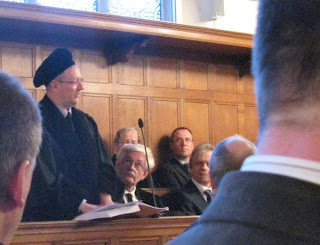
The Academy building houses the auditorium where doctoral promotions are held almost daily. The whole ritual is highly formalized. Right before the defense, the candidate – in concert dress – is led into a little office where the nomenclature is explained to him by the chief of protocol. When answering questions, the promovendus is to address the members of his opposition committee as “highly learned opponent” (when it is a professor), as “very learned opponent” (when it is not a professor), as “highly esteemed promotor” or as “Mister Rector Magnificus”. The promovendus himself is addressed as “Mister Candidate”. The opposition committee are dressed in traditional gowns with an accompanying hat that needs to be put on when speaking.

The promotion itself took place in the old Academy building, the main university edifice since 1581. It used to house the oldest university observatory, and right next to the building booksellers and printers were housed, among them Isaac Elzevier, whose name was later used for the well-known publishing company.