Tuesday, September 28, 2010

ORCiM Research Festival 2010

The Orpheus Institute, where I coordinate the DocARTES curriculum and where I am a fellow at the Orpheus Research Center in Music (ORCiM), has just had its second incarnation of its Research Festival.
The existing conferences are not always the ideal places to present artistic research: reading an article and perhaps letting the participants listen to a recording or illustrate a little on a nearby piano is rarely enough to adequately convey artistic research results. More problematic still, the conference formats do not attract the peers that artistic researchers are looking for. Recognizing the gap in the dissemination chain, the Orpheus Institute established the first Research Festival (since then copied elsewhere), in which the products of artistic research heard, explained and discussed.

Orpheus Instituut, ORCiM, Research Festival 2010, artistic research

The ORCiM Research Festival 2010 is the second installment of this initiative. Its theme was ‘Unexpected Variations’ and it was handled by a bundle of speakers, many of whom ORCiM members, from often very different perspectives. My most vivid recollection regards what one of the two keynote speakers came from Australia for to show us. Stephen Emmerson “re-imagined” some key piano pieces from the first decade of the previous century by multi-mixing his own recordings, i.e. following up on what Glenn Gould had started in the recording studio by manipulating and mixing microphone perspectives like camera angles in cinema. Emmerson’s transposition of that principle (which Gould can be heard and seen here applying to music by Scriabin) to Schoenberg’s opus 11, Berg’s piano sonata and Bartok’s bagatelles opus 6  may not always result in the most convincing showcases for the potential of this technique, but it remains exciting to think of granting artistic license to recording techniques and taking Gould’s initial experiments one or more steps further. 

Stephen Emmerson, remixing modernism, Gould

The CD that was produced to disseminate the findings contains both the original recording and the ‘remix’, including a detailed account of how Emmerson got the idea, contextualized it and realized it. If this project stands for ideals of an artistic research festival, let there be more such events!

Thursday, September 09, 2010

Wagenaar's art of presentation

In 2004 I heard a lecture by Prof. Dr. Albert Wagenaar on how ‘People don’t remember the weather forecast’. This was not the topic but the message. After all these years, every member of the audience that I still meet remembers it - how to achieve this effect was the real topic of Wagenaar’s lecture, which he gave again at the Orpheus Institute last year in front of an audience of doctoral students. 
Willem Albert Wagenaar

At the beginning, Wagenaar explained it was not really a lecture, for he wouldn’t read anything. It was going to be more of a ‘causerie’, a ‘talk.’ And that was exactly what he did: for more than a half hour, without accessories such as paper, microphone, seat, blackboard, PC or beamer, he needed only his voice and his visual presence. He is a very sweet-looking man with the type of voice that makes for excellent radio. Like Garrison Keillor, Wagenaar can draw in your attention with his voice alone, never needing to raise it to be articulate, or searching for words, always at ease and in command. For Wagenaar, to be in command of the audience is the main technique to communicate a message. His work as a clinical psychologist (having been, amongst other, a member of the faculty of law at Leiden University and a renown juror-expert in legal trials) has given him ample opportunity to test this thesis, both as the one who talks and the one who studies those who talk. But it is not just a question of the voice. Wagenaar intended his talk to be of help to people who need to present their doctoral research to a live audience, and filled it with techniques that are necessary to make the difference between an aural and a written presentation. 

The entire talk was structured along a list of such techniques, which each one being demonstrated while being explaining. Form and content matched perfectly. Some of the techniques are very basic, e.g. being on time (excepting force majeure) shows you care as much as those in the audience that are on time. Talking directly to your audience allows them to engage with what you say. Other techniques are less self-evident, e.g. "Do not read from paper": it gives the impression you are not fully prepared and every time you need to look at the paper to know where you are, you lose contact with your audience. Do not hand out bunches of photocopies on which only small items are relevant: these will give the audience the chance to loose concentration and shift their focus. If you need PowerPoint, be aware of how much the frames distract audiences, who are looking at them instead of listening to you. Apart from the risk of technical problems, overhead projections of text (especially listings to follow the structure of the talk) are counterproductive. Some techniques are self-evident but not necessarily easy. If you really command your subject, you must be able to say what you have to say in 10 seconds. The rest is illustration to make that point or to keep the attention of the audience. (Wagenaar is a professional expert on the workings of the human memory.) Unlike reading a brief or a novel, an audience of a talk cannot go back to read something again in case it feels it missed or misunderstood something. The attention span does not last for a half hour, and an audience’s attention will most definitely wander and miss bits. Some of those bits can be crucial to the argument and for someone who misses such a point the whole talk may be wasted. It is therefore important to repeat the message and the crucial points. That’s why the message should be announced at the beginning of the talk rather then spending the first minutes (which are at the most profitable point of the attention span) on how you are happy to be here, and how you suppose the audience might appreciate what happened to you yesterday and how that connects to the subject at hand. Repeating the message and closing of with it can be literally impressive, as Wagenaar demonstrated in both of his talks that I witnessed. Wagenaar compared an aural presentation to an onion, with the core being the message, and the layers the illustrations and attention grabbers. A written account can be structured like the unwinding of a cotton-ball, spinning a long thread of logically connected but sequentially arranged arguments. In an aural presentation such a thread will easily and quickly brake apart. At such points, the structure must then be left for another one to repair the damage: going back to previous stages of the argument and explaining the matter again. This may in turn enlarge the disruption of the thread, and only the most experienced ‘talkers’ may pick up where they had been forced to stop. 

A few of the layers that he used to make these very points are worthwhile relaying here. Simulating a search for the right word can put the audience’s attention back on track: the listeners that feel the urge to complete the sentence will provide some relief in the monotonousness of the talk. If one of the members that you know (organiser, colleague, etc.) is drifting away, you may mention his name in some made-up reference. At least that person will be with it again immediately, and the rest will have occasion to turn their heads and see whom it is that the speaker is referring to. Small tricks like this, expertly timed by Wagenaar, revealed to be more effective than one might expect. 

After Wagenaar’s talk, the students were scheduled to give presentations themselves. Of course, not having prepared with any of his advice in mind, their presentations suffered heavily from the comparison. But a comparison between an experienced presenter like Wagenaar and fresh students (who are already accomplished performers but with sounds instead of words) is unfair. It was much more of a surprise to witness a seminar later that day by someone who was a professional researcher, without a doubt used to lecturing, teaching and presenting. It had certainly not been the intention of the organisers to follow up on Wagenaar’s talk with a demonstration of how it should not be done, but to witness a lecture that did not benefit from his experiences was the best way to learn the lesson that he had come to teach.

Wednesday, March 03, 2010

"Mr. Candidate!"

Luk Vaes, artistic research, Leiden University, PhD, extended piano techniques
On December 22, 2009, I received my doctoral degree from Leiden University (LU). It was their last promotion of that year, and I became the first doctor in the arts to graduate at this old institution.

LU was founded in 1575 as a gift to the city of Leiden by Willem I, Prince of Orange, the main leader of the Dutch uprise against the ruling Spanish. According to legend, the citizens could choose between 10 years of tax free life or a university as the reward for their brave resistance against the Spanish. The university’s motto is Praesidium Libertatis, “a firm fundament of freedom” in the words of Willem of Orange. The university was financed with the selling of confiscated properties of the catholic church. Philip II, then still King of the Netherlands, declared in 1582 that anyone who studied at the university would be suspected of herecy and not authorised to perform in a function of any dignity.

I like the idea of having graduated at this university. For one thing, the spirit of secular freedom suits me, being from the Flemish city of Ghent, which prides itself of a similar history. Ghent citizens had also stubornly resisted the Spanish in those days, refusing to pay taxes to Charles V. To punish Ghent, the emperor humiliated its nobility in 1539 by ordering them to wear nooses around their necks. Since then, the noose has become the Ghent symbol for proud resistance to tiranny and freedom of opinion. Secondly, I like the Dutch. For the past 16 years, I have organised new music concerts in Flanders and the Netherlands in order to exchange Dutch and Flemish musicians and composers. It feels like a curious coincidence that I, with my Flemish background, graduated at a Dutch university through a colaborative effort of Dutch and Flemish institutions. (The trajectory towards the degree was set up by the Academy for Performing Arts of LU (part of the Humanities Faculty), the Orpheus Institute (Ghent), the Royal Conservatory in The Hague, the conservatory of Amsterdam and the Lemmens Institute in Leuven.)

The network of institutions that joined forces for this curriculum is as dinstinguished as the lineage of graduates at LU, among which are listed four Nobel Prize winners. I don’t consider myself a high-end part of that lineage, but the history of LU, and the level at which it is used to operate, is reflected in all aspects of their doctoral promotion ritual. My opposition committee consisted of both the present and former Rector Magnificus of LU, the dean of its Humanities faculty and their professors of Literary Studies and Art History; icons from the musical performance scene like Ton Koopman, Reinbert de Leeuw, Ellen Corver and Bart van Oort; representatives of Amsterdam College for the Arts, the Orpheus Institute, Lemmens Institute and the rector of the Catholic University Leuven; David Rowland (Dean and Director of Studies for the Faculty of Arts, OU Cambridge) and Herman Sabbe (University of Ghent). And, of course, my promotor Frans De Ruiter, founder of the festival for ancient music (Utrecht), director of the Holland Festival, director of the Royal Conservatory of The Hague, and co-conceiver of the Academy for Performing Arts at LU, where I was enrolled as a doctoral student.

Luk Vaes, extended piano techniques, artistic research PhD
Contrary to the regular academic doctoral promotion, artistic promovendi have to defend their findings through an artistic presentation as well as a dissertation. For my subject - Extended Piano Techniques in Theory, History and Performance Practice - I set up three concerts, all presented in the days before the promotion, with solo and chamber music (including some of the original dances to the prepared piano pieces by John Cage) from the early 1700’s to the present day, for the pianoforte, harpsichord, clavichord, organ and contemporary piano.

Leiden University, artistic research PhD, Academy for Creative and Performing Arts

The formal nature of the defense almost ensures that the candidate can have a good time. Once the date for the promotion is set, there is no real fear of failing. Nevertheless, to test the candidate’s ability to hold ground and stand by the conclusions that are formulated in the dissertation, the questions from the opposition committee may be sharp and charging. Historically, at least, the presence of paranymfs seems clearly not to have always been comforting enough, for the ‘waiting’ room, where the academic promovendi are left to calm their nerves before entering the arena, became known as the ‘sweat chamber’. I didn't get to add my signature to the walls of that room, as had the Dutch Queen and other famous Leiden graduates, but I did get some nasty questions from members of the opposition committee who did not aggree with all aspects of my research. I don't know if my confidence came from a musician's stage experience or if it had anything to do with my decendance from proud Ghent noose-wearers, but the attacks couldn't throw me off. The whole promotion was just too much fun.
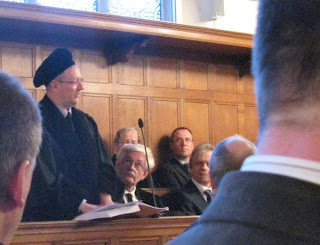
Luk Vaes, artistic research, Leiden University, PhD, extended piano techniques
After exactly 45 minutes (exceptionally it can be 60’) before the chief of protocol enters the auditorium and cries out “Hora Est!” Even if the candidate is in the middle of his explanation, or one of the opposition committee in the middle of a question, the defense comes to a stop and the committee retires for deliberation. During that time, the candidate can be at ease with his two paranymfs. Those are a peculiarity of LU’s promotion procedure. Legend has it that they were originally intended to protect the candidate in case of all too severe arguments from the opposition committee. Later, their function shifted from bodyguard to elegant (female) assistants. I liked the older concept and assigned my two oldest (and bearded) friends Geert and Alfonso to the task.

Luk Vaes, artistic research, Leiden University, PhD, extended piano techniques
The Academy building houses the auditorium where doctoral promotions are held almost daily. The whole ritual is highly formalized. Right before the defense, the candidate – in concert dress – is led into a little office where the nomenclature is explained to him by the chief of protocol. When answering questions, the promovendus is to address the members of his opposition committee as “highly learned opponent” (when it is a professor), as “very learned opponent” (when it is not a professor), as “highly esteemed promotor” or as “Mister Rector Magnificus”. The promovendus himself is addressed as “Mister Candidate”. The opposition committee are dressed in traditional gowns with an accompanying hat that needs to be put on when speaking.

The promotion itself took place in the old Academy building, the main university edifice since 1581. It used to house the oldest university observatory, and right next to the building booksellers and printers were housed, among them Isaac Elzevier, whose name was later used for the well-known publishing company.

Monday, February 01, 2010

A new millenium, a new discipline


In 2000, the EU issued what is known as the Bologna Declaration, a pledge by 29 countries to reform the structures of their higher education system. One of the consequences is that performing artists and composers can now obtain a doctoral degree in the EU. Until then, doctorates where the prerogative of universities and limited to academic programs (e.g. musicology or art history). Higher education outside of universities was limited to first and second degrees (equivalents to bachelor and master degrees) - a D.M.A. or a PhD. in composition, as commonly offered at many US universities, had been non-existent in those EU countries.

Since 2000, the reform has been carried out and musicians and composers can now enroll in more and more art schools (in association with universities) to obtain a doctoral degree. This is all very new to the old continent. Artists had not been considered (or trained) to spend their time writing dissertations and publish articles. The new degrees would require a fundamental rethinking of some educational and professional habits. The question of how scientific an artist’s research should be to be worthy of a doctoral level, and to what point a doctoral dissertation might be artistic, has been the subject of innumerable debates across Europe. Often very heated, these discussions have led institutions to take a stand, shape their curriculum, and start enrolling students in programs that can be very considerably different from school to school.

At the time of starting this blog, only a few doctoral students have finished their ‘artistic research’ in music and have become doctors in the arts – I just promoted a few months ago as the first one at Leiden University, the fourth one in the Low Countries.