Thursday, May 01, 2014

IRCAM PhD positions in compositional research


As announced on the IRCAM website (in French only, according to an ancient tradition, and translated by yours truly):


Research in composition

From Septembre 2014

Université Paris-Sorbonne IV, Pierre et Marie Curie (UPMC), Sorbonne Universités, Ircam
  
Call for candidacy: first forthnight of May on the Ulysses platform
Selection: in June
  
Contact : info-pedagogie@ircam.fr


The implementation of the LMD [bachelor-master-doctorate] system in European higher education institutions implies the need to create these diplomas or their respective degrees (bachelor, master and doctorate) in educational systems where they did not exist before. It also means that the doctoral degree is more generally required for access to teaching positions, even in schools where it did not exist before. A PhD in music, while it existed in Anglo-Saxon countries (UK and U.S.), was not usual in continental Europe, where musical practice is traditionally taught in conservatories and colleges of music rather than at a university. Numerous European countries, faced with this problem, set up doctorates in music, often in the context of collaboration between university and conservatory.

The doctorate in music composition research, organized in collaboration with the University of Paris -Sorbonne, the Pierre and Marie Curie University (UPMC) and IRCAM, is part of this now inevitable movement. Different from the doctorate in musicology, it is aimed at high-level composers holding a master (or an equivalent degree, along with significant experience in composition), who notably propose projects integrating a technological dimension in the compositional process, and eager to pursue a dual career as composer and researcher. The degree awards a double competence of composer, of which the final degree work attests, and researcher, materialized in the defense of a thesis.

Doctoral training is provided jointly by the three institutions; it includes doctoral courses and joint seminars, issued by the Paris-Sorbonne University , UPMC and IRCAM. The degree is based on the production of creative works (which have to relate to the research project) and on the defense of the doctoral thesis before a jury of the partner institutions.


Research topics

This doctorate is open to candidates wishing to conduct their research from one or more of the topics from (but not limited to) the following list:
Material , form and meaning: categories and musical parameters, computer-assisted composition, music/sound/noise, semiotics, thematism and expressiveness.

Instrument and performer: performance modes, gesture, collaboration of performer/composer, acoustic analysis, extended instruments, electronic instrument making.

Voice, text, word: relations music/text, linguistic and phonological/phonetic approaches, semantics and expression, speech synthesis and processing, plurality of languages.

Orchestration , instrumentation: treaties and rules (from the explicitation of the craft to formalization), timbre and instrumentation, computer assisted orchestration.

Interactivity: sound installations, mixed music, improvisation, multimedia.
Sound space and stage: dramaturgy, scenography, opera, theater, architecture, sound spatialisation.

Methodology and transversal aspects: theory and analysis, collaborative creation, process documentation, qualitative and quantitative approaches, perception and cognition, aesthetics and philosophy of art.


The admittance procedure is organised on a competitive bases.

This cycle is open to candidates wishing to jointly practice a high level composer activity and conduct research leading to a thesis in the field of musical creation, all the while aiming for taking part in a dynamic professional employability.

Candidates must hold a national master degree or degrees of CNSMDP or CNSMDL conferring the rank of master, or having studied abroad at a level deemed equivalent by the graduate school, or enjoying validated academic achievements, and demonstrate experience in composition as evidenced by a record of works, a description of which is specified in the call for applications.
Two candidates are selected annually. 

Contracts will be awarded to two candidates.

Opening of the call for applications: the first half of May 2014.


Monday, February 10, 2014

New practice-based PhD positions


The Stockholm University of the Arts (Uniarts) announces ten practice-based Ph.D. positions where the focus is put on the artistic process:

    – Two in Choreography
    – Two in Media
    – Two in Opera
    – Two in Performing arts
    – Two in Visual Art – in collaboration with the Royal Institute of Art


Applications are accepted until February 28, 2014. All info here.


Stockholm University of the Arts, new PhD position, artistic research

Thursday, December 19, 2013

A new journal on and through performance


The first issue of The Scottish Journal of Performance is out. The journal is announced to appear bi-annually, is refereed and of the open access persuasion, and focusses on performance in Scotland and/or wider aspects of performance presented by (early career as well as established) scholars and reflective practitioners based at Scottish academic institutions.


Scottish Journal of Performance, artistic research


That the content is limited to Scotland must have to do with the fact that it is run by doctoral students. Understandable but regrettable, none the less, as  journals on performance – even if it is as wide as this one, encompassing dance, drama, film, music and television – are hard to come by, especially if they specifically wish to include practitioners’ research.


Still, this new publication may be worth keeping an eye on if music becomes a real integral part of its content. The ten articles in its first issue include only one (a book review) that deals with music, and neither the review nor the book offer a practitioner’s perspective, but if one of the backing institutions – the Royal Conservatoire of Scotland – is to be counted on, the future of the journal may look bright to those wanting to keep abreast of new developments in research on/in performance. The Conservatoire’s research arm was already established in 1999, and 85% of their research – "blending traditional research practices with practice-based artistic research, applied research, consultancy and knowledge exchange" – was commended for its recognized international quality. Amongst the diverse aspects of the programme set-up, I would recognise at least the Centre for Voice in Performance, the Contemporary Ensemble-in-Residence and a former ORCiM artistic research colleague of mine on the staff (violinist Mieko Kanno) as potentially delighting the AR community with new research projects that can be made know through the new journal.


Sunday, December 15, 2013

The SHARE Handbook & conflating the arts


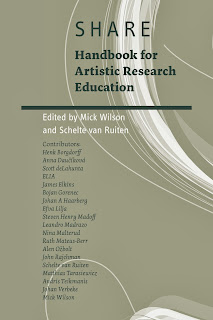
The SHARE network (Step-Change for Higher Arts Research Education) announced its Handbook for Artistic Research Education. (Downloadable here.)

SHARE handbook for artistic research

The book can be of interest for some of the overview articles, e.g. in the contextualizing first chapter “The Third Cycle in Arts Education: a contested construct”, or the surveys in “Contested Values and Critical Debates”. But it is striking how James Elkins’ partial view on the situation worldwide and his ‘Six Cultures of the PhD’ typology do not resonate with the situation in the Low Countries, where, at least when music is concerned, more than five different doctoral programmes in artistic research enrich a single linguistic regional unity.  The “New’ Doctoral Programmes: The Structured PhD and the ‘New Pathway’ Doctoral Programme” chapter specifically seems to relate only really to the visual arts.

It is unfortunate that this emphasis on the visual arts, in both perspective and focus, pervades the whole volume:  except for one case study (out of 11) – Paulo de Assis’ MusicExperiment21 project – there’s hardly anything in it for the musician. And the case studies are illustrations rather than food for integrated discussion, really. To be fair, the 39 partner institutions of SHARE don’t distinguish themselves for being conservatories (even if some are of the larger types, which encompass a music department), and the history of (doctoral) research in the arts is indeed to a large extent to be traced in the fine arts. Still, it remains hard – if possible – to just connect visual arts, design, architecture, music, dance, etc. through research as a perceived common denominator. I will be hard pressed to forget a meeting for the development of the Artistic Research Catalogue, with a large majority of the work group being visual artists, designers, etc., and room for only two musicians (a doctoral student and myself). At some point, when the discussion on what to formally call the presentation of artistic research outcome in the software centered on the concept of ‘exhibiting’ art, my remark that I habitually reproduce someone else’s art rather than create new art (I don’t improvise and I don’t compose), with which I wanted to problematized the narrow view of an artist creating a work that he owns (think of a painter, nowadays, striving to make a career by trying as best he can to paint according to the intentions and skills of Van Eyck), provoked the incredulous response by AR proponent and visual artist Florian Dombois: “But why would you do that?” 

If an understanding of each other’s artistic identity is still to be developed at this level, we better not assume to just equate research interests, methodology, types, goals, target audiences, etc. Judging the content of the SHARE handbook, as well as many conferences on AR (in fact, all those that I have known of), this gap is yet to be acknowledged.

Thursday, November 14, 2013

A move to put our mark on the Frascati Manual


According to its latest newsletter, the Society for Artistic Research wrote a letter to the Organisation for Economic Co-operation and Development (OECD), on August 30, to call for a revision of the Frascati Manual in order to add AR as a new and separate scientific category. (Posted on the society’s FaceBook Timeline on October 29, 2013.)


Frascati Manual, artistic research, tacit knowledge, embedded knowledge


The Frascati Manual was thought of as initiating a “Proposed Standard Practice for Surveys on Research and Experimental Development” to measure Scientific and Technological Activities. Its latest (6th) edition dates 2002 and defines types of research and research personnel, deals with measuring expenditure and personnel resources, and also organizes the "Field Of Science" into main and sub-categories. (Buy here or download its free PDF here.The book is highly influential: worldwide, governments and organisations adopt its definitions for discussing their scientific, technological and economical development policies, and R&D studies acknowledged its function as a standard.

The 2002 edition Field of Science classification was revised in 2006 (freely downloadable here) and is listed as follows:

1. Natural sciences
1.1 Mathematics
1.2 Computer and information sciences
1.3 Physical sciences
1.4 Chemical sciences
1.5 Earth and related Environmental sciences
1.6 Biological sciences (Medical to be 3, and Agricultural to be 4)
1.7 Other natural sciences
2. Engineering and technology
2.1 Civil engineering
2.2 Electrical engineering, Electronic engineering, Information engineering
2.3 Mechanical engineering
2.4 Chemical engineering
2.5 Materials engineering
2.6 Medical engineering
2.7 Environmental engineering
2.8 Environmental biotechnology
2.9 Industrial biotechnology
2.10 Nano-technology
2.11 Other engineering and technologies
3. Medical and Health sciences
3.1 Basic medicine
3.2 Clinical medicine
3.3 Health sciences
3.4 Medical biotechnology
3.5 Other medical sciences
4. Agricultural sciences
4.1 Agriculture, Forestry, and Fisheries
4.2 Animal and Dairy science
4.3 Veterinary science
4.4 Agricultural biotechnology
4.5 Other agricultural sciences
5. Social sciences
5.1 Psychology
5.2 Economics and Business
5.3 Educational sciences
5.4 Sociology
5.5 Law
5.6 Political science
5.7 Social and economic geography
5.8 Media and communications
5.9 Other social sciences
6. Humanities
6.1 History and Archaeology
6.2 Languages and Literature
6.3 Philosophy, Ethics and Religion
6.4 Arts (arts, history of arts, performing arts, music)
6.5 Other humanities


The 6.4 Arts category is specified as containing: Arts, Art history; Architectural design; Performing arts studies (Musicology, Theater science, Dramaturgy); Folklore studies; Studies on Film, Radio and Television. (The 2002 classification saw 6. Humanities as made up merely from 6.1 History, 6.2 Languages and literature, and 6.3 Other humanities.)

The noble but bold request of SAR is to add AR not only to the classification as a new category, but to do so “as a significant category on its own terms.”  The 6.4 Arts category, as “containing various fields of research on art” [my italics] is juxtaposed with the claim that “this classification does not in any satisfactory way reflect the development of artistic research” (i.e. research through art [my italics]). The letter’s phrasing – to see AR as “a field of its own on the 1-digit level” – leaves unclear whether SAR wants AR to sit at the 1-digit level (making it a 7th high-level group) or under it (as a distinct 6.6).

Next to the notion of the unsatisfactory way that AR would compare to the subcategories under 6., the society’s letter states several other reasons for its claim, such as the Frascati manual’s “aims to reflect changes in the nature of contemporary R & D” (the 2006 revision is indeed considerable), and two recent international initiatives to suggest a similar (1-digit position) solution to the perceived problem. Of the latter, one proposal (from the Head of the Economics Statistics department, Statistics Sweden and the Swedish National Agency for Higher Education) was made in November 2010, and the other (from European League of Institutes of the Arts) in January 2012. Both initiatives were addressed to the OECD Head of Economic Analysis and Statistics.

I don’t know if the two previous attempts were left unanswered, nor can I form a good idea as to how complicated it would be to realize a revision of the classification. The international scope of AR is lauded in SAR’s letter as being well networked an widely recognized, but how much of that will (or needs to) impress whatever entity decides over this, is a mystery to me at the moment. More interesting is the question of the validity of creating a new position for AR. I am all for recognizing AR as separate from musicology and artistic practice (see here), agreeing also in full that research on an artistic practice is not necessarily the same as in-and-through it (the latter can comprise the former, but goes one step further in catering conclusions to the needs of the practice). In my personal opinion and experience, it would also be good for AR to be valued as independent in order to safeguard some of the support that an emerging discipline needs. There’s hardly any money for AR (yet), and funding entities divide their financial pie into smaller slices rather than increasing the available resources as a whole to accommodate a new type of player. That there is already little cash to go around, is further mirrored in the facts that a call for an AR position attracts a significant number of interested musicologists, music-theorists or –philosophers, or that these scholars prefer a term such as ‘artist-researcher’ rather than one that identifies a new type that they feel (unjustly, I think) excludes them from participating. For the time being, I prefer to make clear distinctions, as attempts at appropriation (“AR is musicology with a new focus”, as I have heard argue on an AEC symposium a few years ago) will only leave dire chances for the young category to grow. A spot of its own in the Frascati Manual would certainly offer some hopes, if not guarantees, of being recognized, taken seriously and supported on government levels.

But, when reading in the manual (pp. 30-45) about distinctions on the borderline of what it considers to be at the core of the manual, i.e. Research & Development, and what it states should be excluded from R&D, then the matter might not be a small task. An example: “[…]even research by students at the PhD level carried out at universities should be counted, whenever possible, as a part of R&D[…]” (p. 31) [my italics] As it happens, doctoral AR is nearly all we have to show for, really. Fortunately, I am now only concentrating on music in this post – the visual arts have more weight to put on the scales. And for music, if all goes well, output streams can and will grow stronger, broader and faster.

On a conceptual level, however, tougher questions remain. As long as doubts are expressed as to whether or not artistic practice in itself is research, and artistic output be valid as research output, and as long as institutions consider a D.M.A. format (e.g. Portugal) for the doctoral cycle, or restrict doctoral candidates’ options to musicology departments (Germany), the communal AR efforts will stay diluted, and it may be hard to convince the OECD that we don’t fall under arts. And while I go along, to at least a certain extent, with the idea that AR can involve a type of knowledge of its own, I still see quite a few AR dissertations and articles being written that do not benefit from artistic practice, do not demonstrably have an impact on it, and do not bring forth new artistic knowledge.

In any case, I warmheartedly favor SAR’s proposition, and I look forward to hearing of any development in the matter – will keep you posted here.